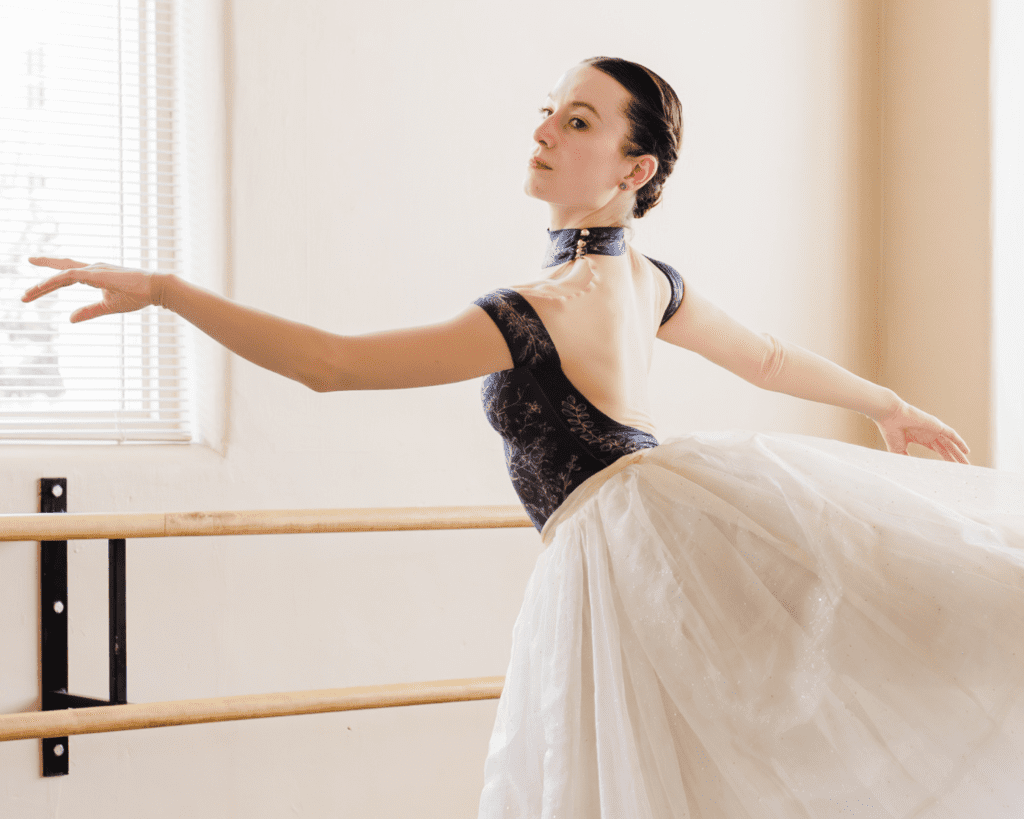
The Ballet Idaho soloist reflects on artistry, confidence, and stepping fully into herself.
Soloist Ashley Baker interviewed by Cassie Mrozinski
CM: This season you choreographed a piece for the trainees, Octaves. Can you talk about your process and how the piece came to life?
AB: Octaves was really fun to work on. It was an interesting process because I put it together very quickly last August, just after choreographing Carnival of the Animals in my home studio in Olympia.
Working with the trainees is amazing–they pick things up so quickly. Some I knew from last season, but many were new, so there’s this challenge of learning who they are as dancers in a very short amount of time. You’re trying to get a sense of that in the first few minutes, which isn’t entirely possible, but it becomes part of the process.
I came in with an idea of a more neoclassical movement language and let that evolve as I got to know them. I also had a piece of music I was really drawn to–a beautiful violin work by Max Bruch–and I knew I wanted to build from that. From there, it became about shaping patterns and movement that could shift and transform seamlessly. I’m really drawn to mirroring and subtle transitions–those moments where formations change without the audience even realizing it.
CM: Was there a collaborative element with the trainees?
AB: Definitely. The dancers were incredibly helpful in that way–they’ll tell you, “This is the most efficient way for me to get from point A to point B,” and that becomes part of the choreography. It was a very collaborative process, and everyone brought such individual strengths. I really wanted each dancer to have a moment to shine and to step into the space and feel ownership of it.
CM: That must be especially meaningful at that stage of their training.
AB: It is. When you’re not quite a professional yet, you don’t always get the opportunity to be alone on stage or fully take up that space. It was really special to watch them grow more confident and more brave as the process went on.
CM: What inspires you to choreograph?
AB: Often it starts with the dancers themselves–or the group I’m working with. From there, I go to the music and think about what would suit them, what would challenge them, and what would feel exciting to perform. Music really leads everything. I’ll listen to something hundreds of times before stepping into the studio. I always want the process to be fun and fulfilling for the dancers, while still pushing them. With trainees, that growth is essential.
With the company, I’m working with friends and colleagues, and I want them to feel their best in the movement. So I go into it with the thought of “What steps are going make you guys feel great, but also be challenging enough that you have something to kind of push for?”
Really, I’m just so inspired by the idea that ballet can and should continue to feel relevant. After seeing so many different kinds of ballets, I’m always thinking about how this art form can remain impactful and meaningful for audiences today.
CM: In working with the trainees, do you see reflections of your younger self?
AB: Very much so. That time in a dancer’s life is incredibly stressful–you’re not sure what’s next, whether you’ll get a contract, how audition season will go.
What I always try to share is that something will work out, even if it doesn’t happen exactly when you expect. It takes patience, which is difficult at that age, but if you stay committed, things unfold.
I also think a lot about something Anne and Garrett told me early in my time here: to treat rehearsals like a performance. For a long time, I held back in the studio.
CM: When you say holding back, do you mean, physically, or in the terms of artistry, or acting?
AB: All of those things. I was so focused on precision and doing everything “correctly” that I didn’t know how to take a step and make it truly my own in the studio. Now, I’ve learned to just go for it.
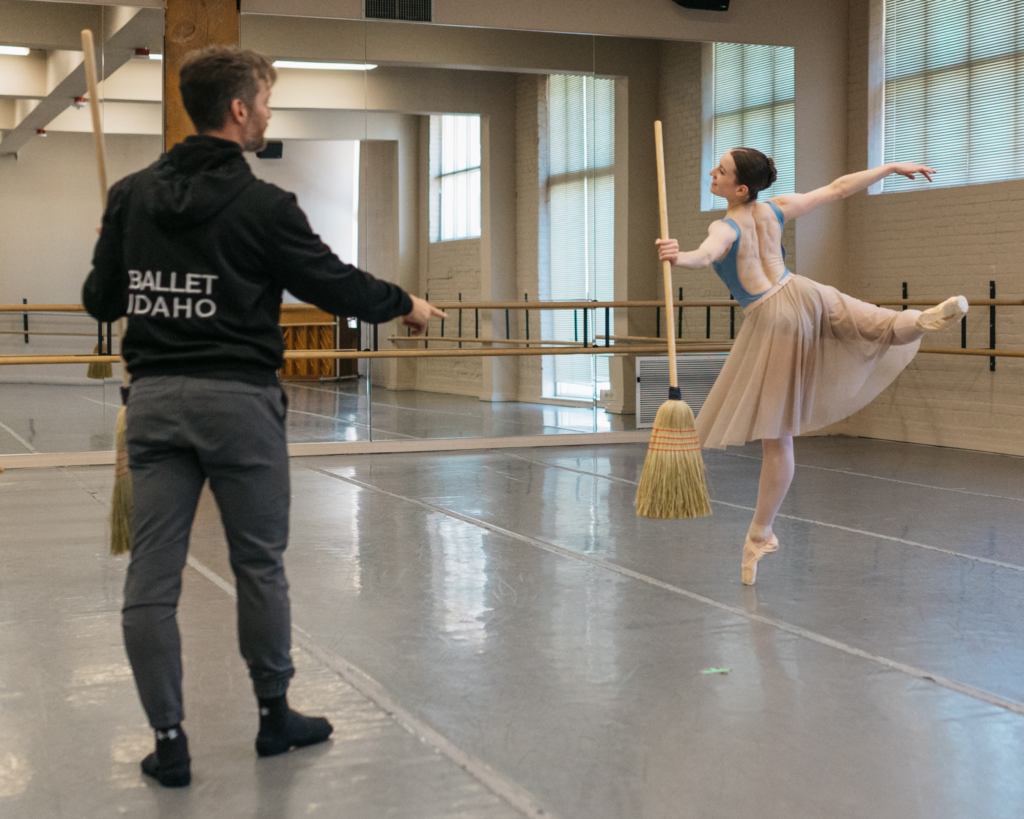
CM: You’re stepping into the title role of Cinderella, which is such a milestone. How are you approaching the character?
AB: I really love how Garrett and Anne are shaping her–not as meek or powerless, but as someone with an inner strength.
She endures a lot, especially in the first act, but I think she knows she’s doing her best. I approach her relationships, even with her stepmother and stepsisters, from a place of empathy. In ballet, we often have these clear archetypes, but I think it’s important to find the humanity in every character. When you’re playing a character who is evil, you can’t believe that you’re evil. You have to look at it like, “I’m this way because I was hurt, or because this thing happened in my life.”
Cinderella is strong–she chooses to find joy where she can and to keep the peace, even in difficult circumstances. There’s something very powerful in that. For example, with her broom solo… The other day in rehearsal, Garrett was talking about this scene as a way she uses cleaning as a tool to calm and soothe herself a little bit. I mean, we’ve all stress-cleaned, right?
CM: Oh, for sure. What has been most challenging in preparing for this role?
AB: I’m really focused on making it my own. There are so many beautiful interpretations–Marianela Nuñez’s Cinderella is one of my favorites. I’ve watched it so many times that I think “I want to do it like that,” but of course, I want to do my own thing. I want to find what feels authentic to me.
And technically…well, it’s just a lot of dancing.
CM: Why do you think Cinderella continues to resonate with audiences?
AB: I think fairy tales are timeless because they have this sense of magic that we want to hold onto even as we grow older. As children, we approach the story thinking that even at the hardest of times in the main character’s life, there is something beautiful that comes out of it and it’s all because of magic. As adults, you have a different lens on it, the magic becomes something deeper… It’s the idea of hope. Fairytales give us the ability to dream.
CM: And add ballet to the fairytale and it is even more beautiful.
AB: It really is. The story is beautiful, the ballet is beautiful–the costumes and sets are stunning. It draws you in completely, whether you’re a young child or seeing it as an adult.
Anne and Garrett are doing such a thoughtful job bringing it to life. Even in the studio, you can already feel how special it’s going to be. And the score is one of my favorites. The music will make you cry, and it will make your heart soar. It’s so powerful. It’s just magic. As a dancer, this role is what I’ve always dreamed of doing.
Ballet Idaho’s Cinderella runs June 5–6 at the Morrison Center for the Performing Arts. Tickets on sale here.