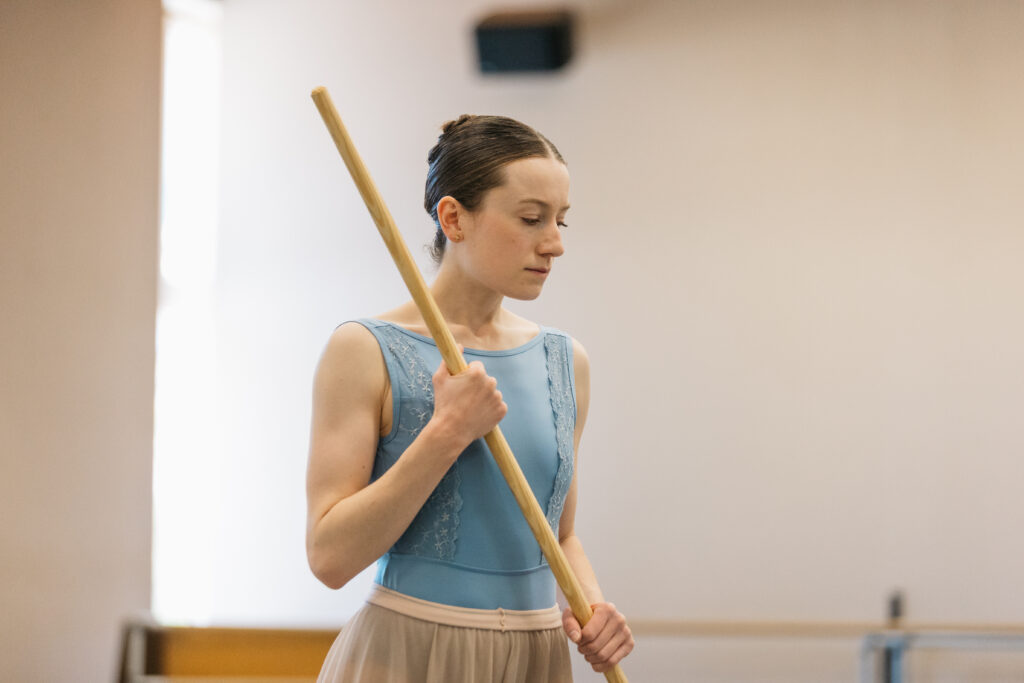
Ballet Idaho’s Cinderella: A Fairytale of Becoming
By Cassie Mrozinski
There is a moment, somewhere between endurance and transformation, when a person begins to recognize their own light. In Ballet Idaho’s Cinderella, that moment is everything.
The tale is well-known. A young girl loses her mother, her father remarries, and then also passes away. She is raised by her stepmother but treated as a servant girl. Rather than centering on rescue, this balletic reimagining turns inward–toward resilience, identity, and the quiet, powerful act of becoming.
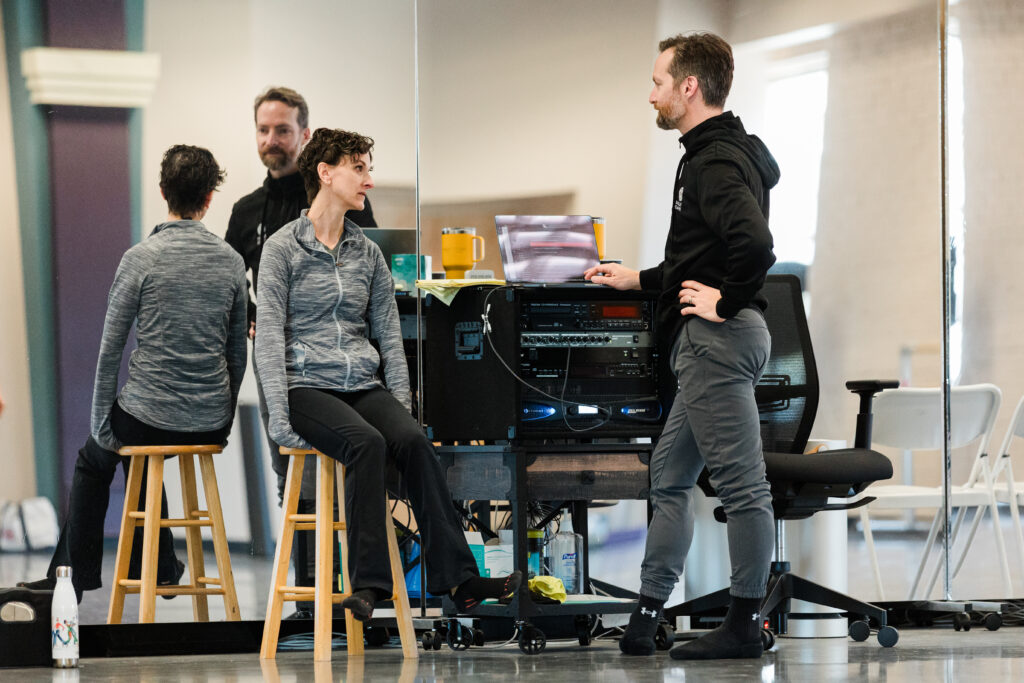
For choreographers Garrett Anderson and Anne Mueller, that shift begins with a deeper understanding of who Cinderella truly is.
“She’s often oversimplified,” Anderson explains. “When you really think about what she’s been through–the environment she’s in, the emotional weight of that–it’s remarkable that she’s still functional. That in itself is a kind of resilience.”
That resilience becomes the foundation of the ballet–not as a single sparkling moment at the ball, but as an ongoing, lived experience. Cinderella navigates a world shaped by vanity and self-absorption, where others are consumed by their own reflections–both literal and metaphorical.
“It’s not really about being rescued,” Anderson continues. “The fairy godmother isn’t creating magic out of nothing–she’s reflecting Cinderella back to herself. And suddenly she sees, ‘Oh… I am this person.’”
While Cinderella’s enduring popularity is sometimes dismissed as a “sleeper princess” narrative–critiquing its passive lead who waits for rescue–its true resonance lies in a profoundly human struggle. The tale endures because it speaks to the universal journey of the underdog, the quest for self-worth, and the deep, authentic desire to be truly seen for one’s inner self, not just one’s appearance.
“There are archetypal things in this tale that we as humans always respond to,” says Anderson. “You want her to win. But the ‘winning’ isn’t about the magical gown or the court—it’s about her inner light.”
Mueller echoes that sentiment: “Her inner light shines.”
“It’s important that she goes back to her rags and the prince is even more in love with her,” says Anderson.
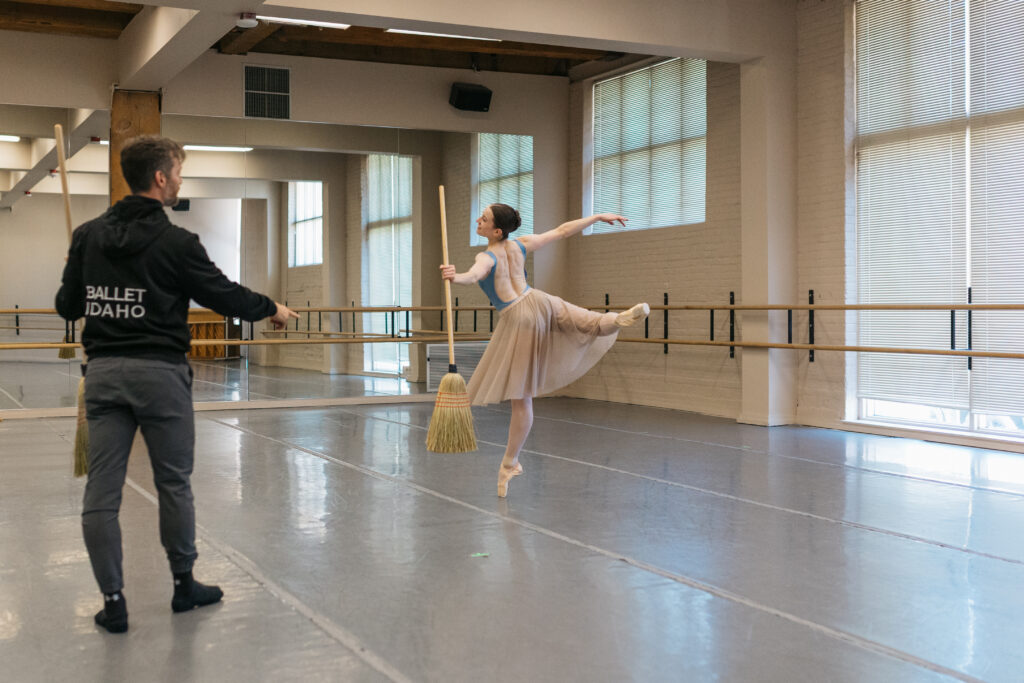
Set to Sergei Prokofiev’s richly complex score, the choreography in Ballet Idaho’s Cinderella mirrors this emotional depth. Unlike the symmetrical musical phrasing of classical ballets like Swan Lake, Cinderella resists easy structure. For Mueller and Anderson, the work started out of the studio, by listening to the music. When asked if there is a certain section of the score that was really difficult to choreograph, Mueller laughs.
“All of it,” she says. “With a composer like, say, Tchaikovsky, you have multiple phrases of eight counts. And that is structurally a pretty easy thing to choreograph to. What I hear with Prokofiev is switching time signatures multiple times within a single piece of music. So there is a bit more homework outside of the studio for both of us to do in advance, so that when we go in there, we know how this music works and we’re ready to give it shape.”
“There’s so much storytelling in the music,” Anderson adds. “It forces you to really listen, to map it out, to respond intuitively.”
Even the collaborative process between Anderson and Mueller reflects this organic approach. Though much of the work has been created separately so far, their shared artistic language leads to moments of unexpected alignment–what they describe as “happy accidents,” where ideas meet without planning.
“In the studio today, I did something and the dancers said, “Oh, that’s like what Anne did, so that’s perfect,” Anderson laughs.
“I think that happens because we know each other so well,” Mueller says. “Sometimes in the studio, I’ll think “I need to put a ‘Garrett’ move in here.”
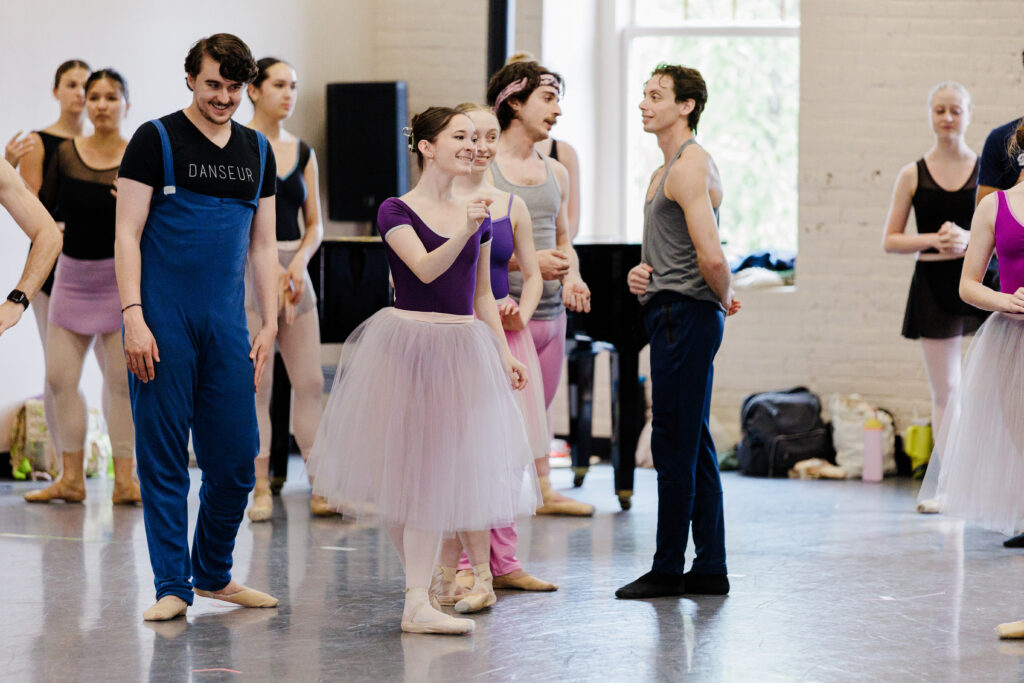
The divvying up of choreographic duties was seamless. Mueller enjoys the large group choreography, and so she took the forest scenes. Anderson gravitates toward the storytelling moments, so he took the kitchen scenes. And they shared both the ballroom choreography and the pas de deux between Cinderella and the Prince.
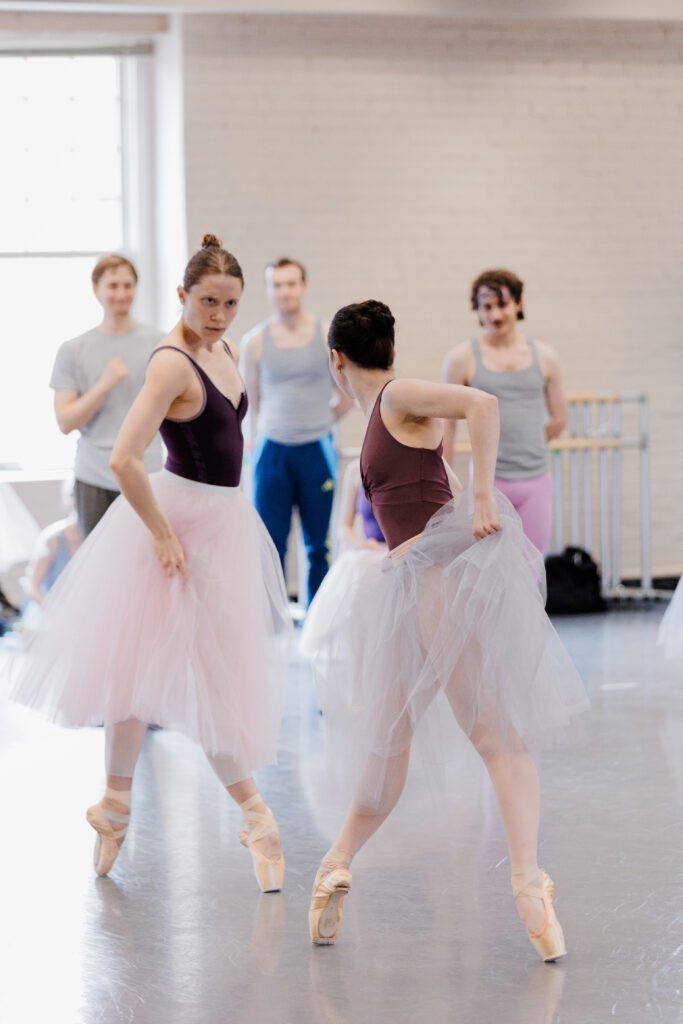
Their version, while emotionally layered, is not without humor.
In many productions, the stepsisters provide exaggerated comic relief. Here, the comedy is more nuanced–drawn from recognition rather than parody.
“I didn’t want the stepsisters to be completely over-the-top,” Anderson explains. “The music already carries a humorous tone. The comedy comes from smaller, more instinctual choices–the kind where you think, ‘Oh, I’ve met someone like that.’”
This restraint allows the world of Cinderella to feel more real, and therefore more resonant. The characters are not traditional evil villains; rather, they are absorbed in themselves, largely unaware of the harm they cause.
That sense of integrated humor extends beyond the household scenes. Mueller is also weaving comedy into the ballroom scenes, “a kind of humorous atmosphere amongst the court,” she says.
“It’s all those BBC shows you’ve been watching,” Anderson teases.
Mueller laughs and agrees. “I do watch a lot of those historical dramas on PBS,” she admits, before adding, “I think it works best when the humor lives throughout the story– not just in the moments where we’re told, ‘These are the people you have to laugh at.’”
And of course, the dancers are central to making that work.
“We’re very fortunate,” Anderson says. “Our dancers are funny. They’re really leaning in—and it’s great.”
At its core, Ballet Idaho’s Cinderella is not about transformation in the traditional fairytale sense. It is not about becoming someone totally new–or solely about the glow-up (even though that part is undeniably dreamy)–but about recognizing who has been there all along.
The fairy godmother serves not as a magician, but as a guide. The ball is not an escape, but a revelation. And the ending is not a reward, but a return to self.
For both Anderson and Mueller, the opportunity to build this world from the ground up–without a fixed choreographic template–has been essential.
“We’re creating something specifically for the artists in this company,” Mueller says. “It’s tailored to their strengths–their technique, their artistry, their theatricality. It’s designed for them.”
And that specificity makes this Cinderella feel not only fresh, but personal. Come for the iconic fairytale and the exquisite dancing–and discover something deeper.
Ballet Idaho’s Cinderella runs June 5–6 at the Morrison Center for the Performing Arts.